Black Friday has a way of making every promotion feel like a numbers game. Twenty percent becomes thirty, thirty becomes forty, and before long it can seem as if the only way to compete is to put the whole store on sale. For independent retailers, that is rarely the smartest approach.
A strong Black Friday promotion does not need to be the biggest one. It needs to feel clear, relevant and worthwhile to the customer, while still leaving enough room for the rest of the season.
1. Start with the offer, not the discount
Before deciding how much to take off, decide what you actually want the promotion to do. A storewide discount is only one way to approach Black Friday. You could focus the promotion on a smaller selection of products, use a spend threshold to encourage a
higher basket value, or add a gift with purchase to make the offer feel more rewarding without changing the price of every item.
The key is to make the offer easy to understand and relevant to the way your customers already shop.
For example, a homeware retailer could build a hosting offer around
glassware, candles and table accessories. A beauty store could create a small gifting set around
hand care and accessories. A lifestyle store might combine a
mug,
socks and a small treat into an easy gift. The promotion still feels special, but you keep more control over what you are giving away.
2. Work backwards from the price the customer sees
Instead of starting with “we’ll offer 20% off,” start with the price you want the customer to see and work backwards from there. If a product normally sells for €50 and you want to offer it for €40, look at the wholesale cost and ask what that leaves you with. Is the remaining margin still healthy once you account for shipping, packaging and other costs? If not, the promotion may need a different structure.
This is where buying well in the first place matters. A competitive wholesale price gives you more room to create an attractive offer without cutting too deeply into your margin. If you are already confident in a product and expect to sell through a larger quantity, it is also worth checking whether the brand offers volume discounts. A lower unit cost can create more room in your Black Friday pricing, as long as the extra stock still makes sense for your store. Shipping costs are worth factoring in too. A free shipping offer or threshold can lower the real cost of your order and give you a clearer picture of how much promotional room you actually have.
3. Create more room before Black Friday starts
The easiest time to protect your margin is before the event, when you are still buying. A better wholesale price gives you more options later, while flexible payment terms can give you more breathing room when stocking up ahead of a busy sales period. With a stronger buying price, you can keep your retail price as it is, use part of the extra margin for a promotion, or put together a stronger offer without cutting into your margin as quickly.
On the Orderchamp Marketplace, the
Best Price Guarantee badge can help you spot products with competitive wholesale pricing and compare opportunities more easily. The same applies during the
Digital Fair, where participating brands make selected collections available with exclusive offers. That extra buying room does not have to be passed straight on to the customer. It can simply give you more flexibility when shaping your Black Friday offer.
4. Keep your commitment flexible
Black Friday can make it tempting to buy deeper than usual, but more stock does not automatically mean more sales. If you are testing a new brand, gifting idea or seasonal category, smaller first orders can help you reduce risk. The
Low Order Minimum filter makes it easier to find brands you can test with a smaller first order. That can be especially useful when you want to test several directions at once, from small gifts and beauty to hosting products or seasonal accessories. For more inspiration on balancing seasonal products with dependable sellers, read our guide on
building an Autumn/Winter assortment.
If one direction performs well, you can reorder. If it does not, you have not tied up too much budget in stock that still needs to move in December.
5. Make the promotion feel valuable
Customers do not only respond to bigger percentage signs. They respond to offers that feel useful, timely and easy to understand. That could mean a bundle, a spend threshold, a limited gift with purchase or a short promotional window.
A bundle can be particularly effective because it lets you create value through curation. Pair a candle with a holder, combine a mug with a gourmet treat or build a small self-care set with hand cream, soap and a beauty accessory.
For independent retailers, that curation is an advantage. You know which products work well together, and Black Friday can be a good moment to turn that knowledge into an offer.
6. Choose the right timing
Black Friday no longer has to mean one Friday, but that does not mean your promotion needs to run for weeks either. A shorter offer can create more urgency, while early access can give loyal customers something extra without extending the public promotion. You might open the offer to your newsletter subscribers first, run it across the Black Friday weekend, or keep selected deals available through Cyber Monday.
The right timing depends on your store and your customers. Plan it around the moments that matter most for your audience, and use your wider retail calendar to make sure Black Friday supports, rather than disrupts, the rest of your seasonal activity.
7. Protect what comes after Black Friday
Black Friday sits right at the start of one of the most important retail periods of the year, so every promotion should also make sense for December. Before launching an offer, think about what it leaves you with afterwards. Are you discounting products that would still sell well as Christmas gifts? Are you moving stock that will remain relevant throughout winter? Can your Black Friday display transition naturally into holiday merchandising? The strongest promotions create momentum without making the rest of the season harder.
That is why a selective approach can work so well. You can create excitement around part of your assortment while keeping the rest ready for the weeks ahead.
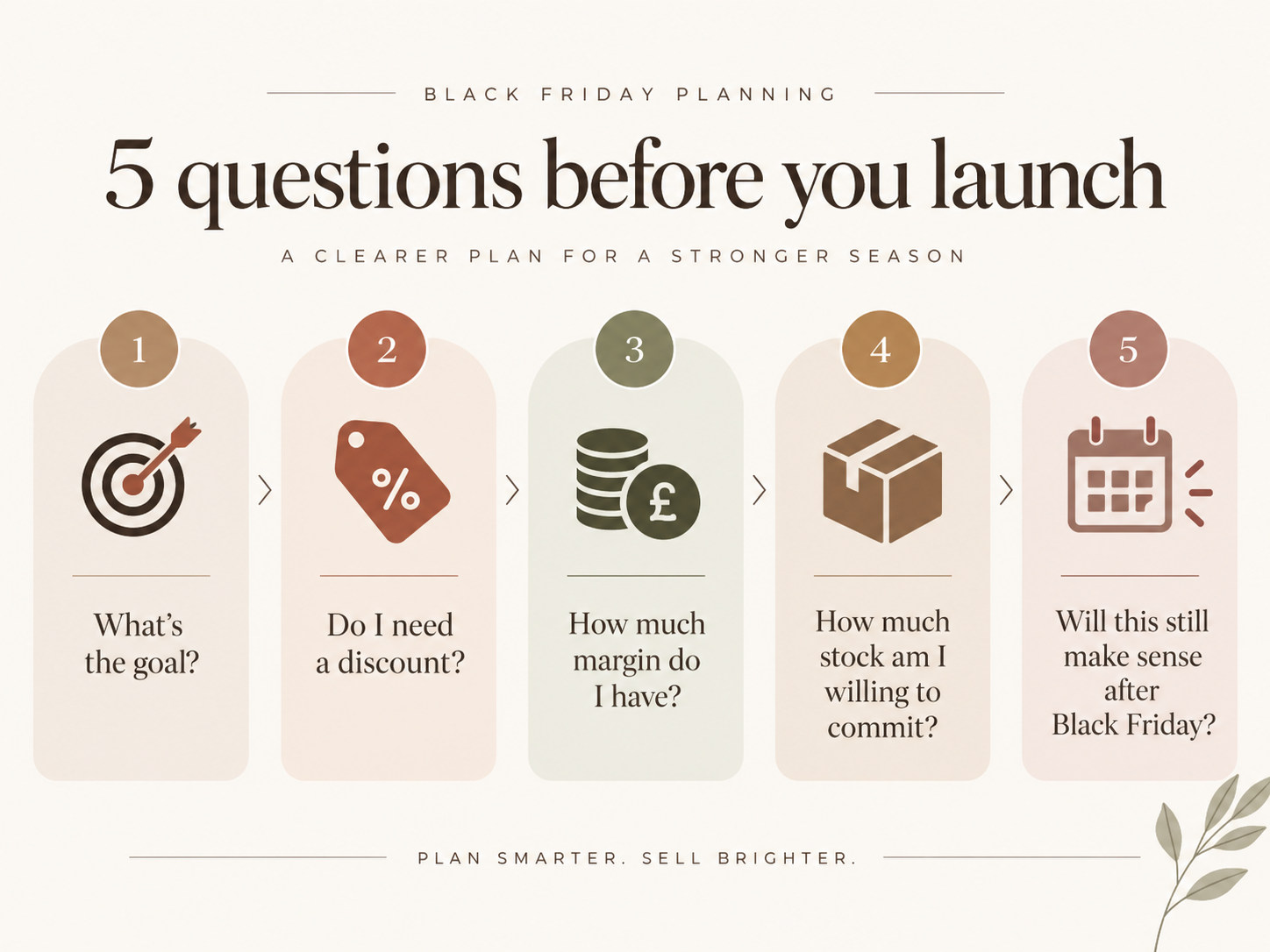
Five questions to ask before you launch
Before deciding what your Black Friday promotion will look like, ask:
- What do I want this offer to achieve?
- Do I need a discount to achieve it?
- How much room do I have in my margin?
- How much stock am I willing to commit?
- Will this still make sense after Black Friday?
Black Friday can be a strong moment for independent retailers, but it does not have to become a competition over who can discount the most. Buy with enough room, keep your commitments flexible and build an offer that works for your store as well as your customer. The best Black Friday promotion is not necessarily the one with the biggest percentage sign. It is the one that creates a clear reason to buy without giving away more than you need to.

.svg)



-1.jpg?width=1200&length=1200&name=1200x1200_fill%20(1)-1.jpg)

-3.jpg?width=1200&length=1200&name=800x800%20(1)-3.jpg)
-2.jpg?width=1200&length=1200&name=1200x1200_fill%20(2)-2.jpg)
.jpg?width=1200&length=1200&name=1200x1200_fill%20(3).jpg)